MST0052
<!-- .slide: class="title-slide" --> <p class="kicker">MST0052 · Lecture 7 · Fall 2026</p> ## Model Selection<br>and Cross-Validation ### Vegard H. Larsen — BI Norwegian Business School --- <!-- Section A — Opening --> ## Where we are L6 gave the **vocabulary**. Today, the **toolkit**. 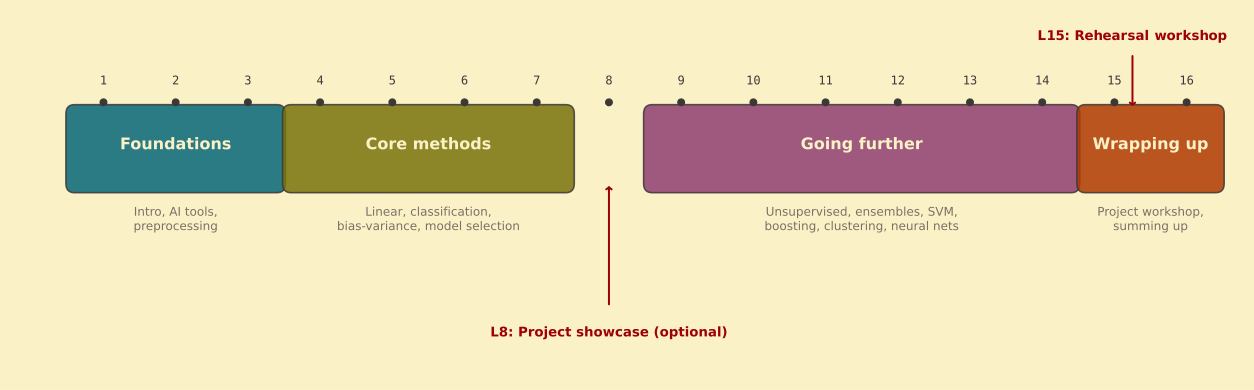 --- <!-- .slide: class="big-statement" --> Finding the sweet spot is easy. Finding it **without cheating** is the whole game. Every slide today is a cheat-prevention device. <!-- .element: class="muted" --> --- ## Today's plan <p class="kicker">90 minutes · one protocol · three families</p> - **Cross-validation** in depth — k-fold, stratified, time-series - **Hyperparameter search** with `GridSearchCV` - The **metric** is a modelling choice - **Worked example:** three families, one rule --- <!-- Section B — From L6 to a rule --> <!-- .slide: class="section-divider" data-background-color="#282828" --> <p class="kicker">01</p> ## From L6 to a rule --- ## L6 in one sentence > Out-of-sample error has a sweet spot in model complexity. The job is to find it without cheating. Today: *how* — in code, on real data. --- ## Model selection is workflow selection > **preprocessing + features + algorithm + hyperparameters** You compare *workflows*, not algorithms. --- ## The three sets <div class="cols-3"> <div class="callout"> <h3>Training</h3> <p>Fit the model. Touched every time.</p> </div> <div class="callout"> <h3>Validation</h3> <p>Tune and compare. Many times — never the final score.</p> </div> <div class="callout warn"> <h3>Test</h3> <p>One final, honest number.</p> </div> </div> --- <!-- .slide: class="big-statement" --> The test set is touched **exactly once**. Tune against it and it stops being a test set. <!-- .element: class="muted" --> --- ## Why one split isn't enough <div class="cols"> <div class="callout"> <h3>One split</h3> <p>One noisy number. The seed decides the winner.</p> </div> <div class="callout"> <h3>Cross-validation</h3> <p>Averages over the luck of the split.</p> </div> </div> --- <!-- Section C — Cross-validation --> <!-- .slide: class="section-divider" data-background-color="#282828" --> <p class="kicker">02</p> ## Cross-validation --- ## k-fold cross-validation  Fit on $k-1$ folds, score the held-out one — report **mean ± std**. --- ## What CV estimates <div class="callout"> **CV scores the workflow, not a fitted model.** </div> After CV picks, **refit on the full training set** — that's the model you ship. --- ## Stratified k-fold <div class="cols"> <div class="callout"> <h3>Classifier + cv=5</h3> <p><strong>Stratified</strong> by default — class ratios preserved per fold.</p> </div> <div class="callout"> <h3>Regressor + cv=5</h3> <p>Plain KFold — no stratification.</p> </div> </div> `cv=5` means **different things** for classifiers and regressors. --- ## cross_val_score ```python from sklearn.model_selection import cross_val_score, StratifiedKFold from sklearn.pipeline import make_pipeline from sklearn.preprocessing import StandardScaler from sklearn.linear_model import LogisticRegression pipe = make_pipeline(StandardScaler(), LogisticRegression(max_iter=5000)) cv = StratifiedKFold(n_splits=5, shuffle=True, random_state=42) scores = cross_val_score(pipe, X_train, y_train, cv=cv, scoring='f1') print(f"CV F1: {scores.mean():.3f} ± {scores.std():.3f}") ``` <p class="muted">Pass a splitter object for full control — <code>shuffle=True</code> matters when rows are ordered.</p> --- ## When k-fold is wrong: time series <div class="callout warn"> Shuffled k-fold trains on the **future** to predict the **past**. That's a leak. </div> ```text Fold 1: [train: 0..n1] [val: n1..n2] Fold 2: [train: 0..n2] [val: n2..n3] Fold 3: [train: 0..n3] [val: n3..n4] ``` `TimeSeriesSplit` — train up to a cut point, validate on the next block. --- ## Match the splitter to your data <p class="kicker">Reference — screenshot this</p> | Splitter | When | |----------|------| | `KFold` | Regression on i.i.d. data | | `StratifiedKFold` | Classification — preserves class ratios | | `ShuffleSplit` | Many random train/val splits | | `GroupKFold` | Grouped rows (patients, users) that must not cross folds | | `TimeSeriesSplit` | Temporal data | Defaults are safe only for unstructured i.i.d. data. <!-- .element: class="muted" --> --- <!-- Section D — The search --> <!-- .slide: class="section-divider" data-background-color="#282828" --> <p class="kicker">03</p> ## The search --- ## The search problem Every knob value is a **different workflow** — with its own CV score. Hand-tuning ("I tried 0.1 and it looked OK") is **not reproducible.** We need a search. --- ## GridSearchCV ```python from sklearn.model_selection import GridSearchCV from sklearn.ensemble import RandomForestClassifier pipe = make_pipeline(StandardScaler(), RandomForestClassifier(random_state=42)) param_grid = { 'randomforestclassifier__n_estimators': [100, 300], 'randomforestclassifier__max_depth': [None, 5, 10], 'randomforestclassifier__min_samples_leaf': [1, 5], } search = GridSearchCV(pipe, param_grid, cv=5, scoring='f1', n_jobs=-1, return_train_score=True) search.fit(X_train, y_train) print(f"Best CV F1: {search.best_score_:.3f}") print(f"Test F1: {search.score(X_test, y_test):.3f}") ``` <p class="muted">The test set is touched once — the <strong>last line</strong>.</p> --- ## Read cv_results_, not just best_params_ ```python import pandas as pd results = pd.DataFrame(search.cv_results_) cols = ['mean_train_score', 'mean_test_score', 'std_test_score', 'param_randomforestclassifier__max_depth'] print(results[cols].sort_values('mean_test_score', ascending=False).head()) ``` The **std** tells you whether the winner is stable. --- ## Grid, random, halving <div class="cols-3"> <div class="callout"> <h3>Grid</h3> <p>Small space — full coverage.</p> </div> <div class="callout"> <h3>Randomized</h3> <p>Large or continuous space — sample n configs.</p> </div> <div class="callout"> <h3>Halving</h3> <p>Many configs — eliminate losers early.</p> </div> </div> **Grid** for 1–2 knobs. **Randomized** past 3–4. --- ## The metric is the search's objective <div class="callout warn"> **The wrong metric is silent.** The code runs, the search finishes — the answer is wrong for your problem. </div> Whatever you pass to `scoring=` is what wins. --- ## scoring= strings <div class="chips"> **Regression** `r2` `neg_mean_squared_error` `neg_root_mean_squared_error` `neg_mean_absolute_error` **Binary** `accuracy` `f1` `roc_auc` `average_precision` **Multi-class** `f1_macro` `f1_weighted` `balanced_accuracy` </div> <p class="muted">Loss metrics are negated — the <code>neg_</code> convention. Backup slide explains.</p> --- ## Multi-metric evaluation ```python search = GridSearchCV( pipe, param_grid, cv=5, scoring={'f1': 'f1', 'roc_auc': 'roc_auc'}, refit='f1', ) ``` Optimise on F1 — *report* ROC-AUC too. Same selection rule. --- ## The pattern, end to end <p class="kicker">The pattern · memorise this</p> 1. **Split** off the test set. Lock it. 2. **Build** a `Pipeline` — preprocessing + model 3. **Define** the grid with `stepname__param` keys 4. **GridSearchCV** with the right splitter and metric 5. **Inspect** `cv_results_` — not just `best_params_` 6. **Score** on the test set — once --- <!-- Section E — Pitfalls --> <!-- .slide: class="section-divider" data-background-color="#282828" --> <p class="kicker">04</p> ## Pitfalls --- ## Leakage inside CV <p class="kicker">Pitfall 1 · The L3 rule, per fold</p> <div class="cols"> <div class="callout warn"> <h3>Wrong</h3> <p>Scale the training set, <em>then</em> cross-validate — the scaler saw the validation folds.</p> </div> <div class="callout"> <h3>Right</h3> <p>Scaler <strong>inside the pipeline</strong> — refit on each fold's training data.</p> </div> </div> --- ## The winner's curse <p class="kicker">Pitfall 2 · Optimism from the best CV score</p> <div class="cols"> <div class="stat stat--word stat--red"> <span class="stat-value">best_score_</span> <span class="stat-label">optimistic — a max<br>over many tries</span> </div> <div class="stat stat--word stat--green"> <span class="stat-value">score(X_test)</span> <span class="stat-label">honest — touched once</span> </div> </div> --- ## Too many tries <p class="kicker">Pitfall 3 · One of 50 workflows will look great by chance</p> <ul class="checklist"> <li class="no">The winner sits at the <strong>edge of the grid</strong></li> <li class="no">The best score's std is tiny next to the gaps between configs</li> <li class="no">A different <code>random_state</code> crowns a different winner</li> </ul> Defence: focused grid, **simpler on ties**, re-run with another seed. --- ## Nested CV <p class="kicker">The rigorous upgrade</p> ```python from sklearn.model_selection import cross_val_score, StratifiedKFold inner = StratifiedKFold(n_splits=3, shuffle=True, random_state=0) outer = StratifiedKFold(n_splits=5, shuffle=True, random_state=1) search = GridSearchCV(pipe, param_grid, cv=inner, scoring='f1') nested = cross_val_score(search, X_train, y_train, cv=outer, scoring='f1') ``` The outer loop scores the **whole procedure — tuning included.** <p class="muted">For coursework, GridSearchCV + a held-out test set is enough.</p> --- <!-- Section F — Worked example --> <!-- .slide: class="section-divider" data-background-color="#282828" --> <p class="kicker">05</p> ## Worked example — three families --- ## The protocol <p class="kicker">load_wine() · same splits · same metric · same rule</p> <div class="cols-3"> <div class="stat stat--blue"> <span class="stat-value">178</span> <span class="stat-label">samples</span> </div> <div class="stat stat--green"> <span class="stat-value">13</span> <span class="stat-label">chemical features</span> </div> <div class="stat"> <span class="stat-value">3</span> <span class="stat-label">classes · f1_macro</span> </div> </div> All three families compete under the **same rule** — that's what makes it fair. --- ## Step 1 — Lock the test set <p class="kicker">Step 1 · Lock the test set</p> ```python from sklearn.datasets import load_wine from sklearn.model_selection import train_test_split X, y = load_wine(return_X_y=True, as_frame=True) X_train, X_test, y_train, y_test = train_test_split( X, y, test_size=0.2, random_state=42, stratify=y ) ``` 80/20, stratified, seeded — **locked.** --- ## Family 1 — Logistic regression <p class="kicker">Family 1 · Logistic regression</p> ```python from sklearn.linear_model import LogisticRegression pipe_lr = make_pipeline(StandardScaler(), LogisticRegression(max_iter=5000)) grid_lr = {'logisticregression__C': [0.01, 0.1, 1.0, 10.0]} search_lr = GridSearchCV(pipe_lr, grid_lr, cv=5, scoring='f1_macro') search_lr.fit(X_train, y_train) ``` Best C = 0.1 · CV f1_macro = **0.993 ± 0.015** --- ## The U-curve, in the wild  Your grid **samples a curve** — steep rise, then a plateau. --- ## Family 2 — k-NN <p class="kicker">Family 2 · k-NN</p> ```python from sklearn.neighbors import KNeighborsClassifier pipe_knn = make_pipeline(StandardScaler(), KNeighborsClassifier()) grid_knn = {'kneighborsclassifier__n_neighbors': [3, 5, 11, 21, 41]} search_knn = GridSearchCV(pipe_knn, grid_knn, cv=5, scoring='f1_macro') search_knn.fit(X_train, y_train) ``` Best k = 41 · CV f1_macro = **0.974 ± 0.025** <p class="muted">k = 41 is the <strong>edge of the grid</strong> — Pitfall 3 says: extend it.</p> --- ## Family 3 — Random forest <p class="kicker">Family 3 · Random forest</p> ```python from sklearn.ensemble import RandomForestClassifier pipe_rf = make_pipeline(RandomForestClassifier(random_state=42)) grid_rf = { 'randomforestclassifier__n_estimators': [100, 300], 'randomforestclassifier__max_depth': [None, 5, 10], } search_rf = GridSearchCV(pipe_rf, grid_rf, cv=5, scoring='f1_macro', n_jobs=-1) search_rf.fit(X_train, y_train) ``` CV f1_macro = **0.986 ± 0.027** — no scaling needed, same protocol. --- ## Honest comparison <p class="kicker">One loop · one table</p> ```python for name, s in [('Logistic', search_lr), ('k-NN', search_knn), ('RF', search_rf)]: cv = s.best_score_ cv_std = s.cv_results_['std_test_score'][s.best_index_] test = s.score(X_test, y_test) print(f"{name:9s} CV = {cv:.3f} ± {cv_std:.3f} Test = {test:.3f}") ``` The number is not the story — the **spread across folds** is. --- ## The numbers <p class="kicker">Test f1_macro · CV mean ± std underneath</p> <div class="cols-3"> <div class="stat stat--blue"> <span class="stat-value">1.000</span> <span class="stat-label">Logistic · CV 0.993 ± 0.015</span> </div> <div class="stat"> <span class="stat-value">0.923</span> <span class="stat-label">k-NN · CV 0.974 ± 0.025</span> </div> <div class="stat stat--green"> <span class="stat-value">1.000</span> <span class="stat-label">RF · CV 0.986 ± 0.027</span> </div> </div> --- ## Which one would you ship? <ul class="checklist"> <li>Logistic and RF <strong>tie</strong> within their CV std → ship the <strong>simpler</strong> one: logistic</li> <li class="no">k-NN's winner sits at the <strong>grid edge</strong> → extend before judging it</li> <li class="no">Test ≪ CV for a winner → suspect the <strong>winner's curse</strong></li> </ul> --- <!-- Section G — Report and ship --> <!-- .slide: class="section-divider" data-background-color="#282828" --> <p class="kicker">06</p> ## Report and ship --- ## What to report <p class="kicker">Your project · all six, every family</p> <div class="checklist"> - The **pipeline** — preprocessing + model - The **CV protocol** — splitter, k, seed, stratification - The **metric** — and why it matches the problem - The **grid** searched - The chosen config's CV score — **mean ± std** - The **test score** — reported once </div> --- <!-- .slide: class="big-statement" --> A reproducible **selection rule** beats a "best model" claim. The rule survives a data update. The number does not. <!-- .element: class="muted" --> --- ## Three words for this lecture <div class="cols-3"> <div class="stat stat--word stat--blue"> <span class="stat-value">Protocol</span> <span class="stat-label">same data, same splits,<br>same metric</span> </div> <div class="stat stat--word stat--green"> <span class="stat-value">Search</span> <span class="stat-label">GridSearchCV — and read<br>cv_results_</span> </div> <div class="stat stat--word"> <span class="stat-value">Once</span> <span class="stat-label">the test set, exactly</span> </div> </div> --- ## Before Lecture 8 <div class="checklist"> - **Run** today's wine workflow on your machine - **Apply** the protocol to your dataset — at least two families </div> All the code is on the course site. <!-- .element: class="muted" --> --- <!-- .slide: class="big-statement" --> ## Questions Backup slides below — press down ↓ <!-- .element: class="muted" --> -- ## Leave-one-out CV <p class="kicker">Resampling · the k = n limit</p> - Each fold leaves out a **single observation** - Lowest bias, highest variance, slowest — $n$ fits For everything but tiny samples, **k = 5 or 10 is the right answer.** -- ## Repeated k-fold <p class="kicker">Resampling · tighter estimates</p> ```python from sklearn.model_selection import RepeatedStratifiedKFold cv = RepeatedStratifiedKFold(n_splits=5, n_repeats=10, random_state=0) scores = cross_val_score(pipe, X_train, y_train, cv=cv, scoring='f1') ``` Averages over multiple shuffles — a tighter estimate at 10× the cost. -- ## Calibration in model selection <p class="kicker">Beyond one metric · when probabilities matter</p> ```python from sklearn.metrics import brier_score_loss y_prob = search.best_estimator_.predict_proba(X_test)[:, 1] print(f"Brier: {brier_score_loss(y_test, y_prob):.3f}") ``` Evaluate **calibration** alongside discrimination (AUC, F1). -- ## Why neg_mean_squared_error? <p class="kicker">Convention · why the score is negative</p> ```python search = GridSearchCV(pipe, grid, cv=5, scoring='neg_mean_squared_error') print(f"Best CV MSE: {-search.best_score_:.3f}") ``` scikit-learn **maximises** — so loss metrics are negated. -- ## Permutation importance <p class="kicker">After selection · interpreting the winner</p> ```python from sklearn.inspection import permutation_importance result = permutation_importance( search.best_estimator_, X_test, y_test, n_repeats=20, random_state=0, scoring='f1_macro' ) ``` <p class="muted">Model-agnostic, and more honest than <code>.feature_importances_</code> for trees.</p> --- ## What's next **Lecture 8:** Project showcase (optional) - Volunteers present their project to the class - Feedback from me, ideas from your classmates - Not presenting? Come anyway — half the value is in the audience